Literary Grave-robbing
| Posted on: Tuesday, December 06, 2011 |
Blog
Category: 'Literary Grave-robbing' |
When I began to write fiction, I was drawn towards stories set in the past because I had a love affair with literary history. Erotic poetry has a particularly strong pull for me, so it's not surprising that my two novels explore the intimate lives of real poets who wrote magnetically-charged love poems. I guess you could call this literary grave-robbing.
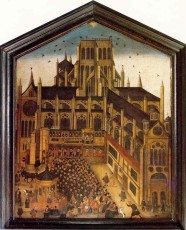
My first novel Conceit (Doubleday 2007) arose from my fascination with the poet John Donne and his seven children, especially his enigmatic daughter Pegge. I read his poems and studied maps and drawings of seventeenth-century London. However, the story didn't really spark until I dreamt that Pegge rescued her father's effigy out of the holocaust in Saint Paul's cathedral during the Great Fire of 1666. This was such an obsessive act of father-love, so bizarre and so provocative, that I was hooked on Pegge and set out to discover, not in history but in my fictional world, what drove her to it.
Muse, the novel that I am just finishing, is also set in an historical city heaving with life--Avignon in the fourteenth century when the popes lived there. When I visited the immense palace of the popes, I was stunned by the secular frescoes in Pope Clement VI's bedchamber and found myself wondering what exactly went on there. It didn't take much research to confirm that the Avignon popes were no saints. In fact, Clement had an unofficial hostess, the Countess of Turenne, whom he called his "niece"--quotation marks supplied by my fertile imagination.
Although the church has swept much of the dirt under the rushes, we can't ignore the poet Francesco Petrarch, who wrote scorching letters about the pope's vices. I'd always admired his sonnets about the noble, un-beddable Laura. Now I was finding out that, far from being chaste himself, he fathered two children out of wedlock. Who was this flesh-and-blood woman he never married? Was she a scholar, a nun, a courtesan--maybe even the Pope's "niece"? The facts sparked off one another and ignited into fiction. I now had my main character, Solange, who began telling the story in her own voice. As she navigates the labyrinth of her life, her eyes and ears bring the dark corners and deep pleasures of old Avignon alive for us.
Thanks to Gail Anderson-Dargatz for inviting me to write this as the first guest blog on her new website, www.gailanderson-dargatz.ca
Group Read of Conceit on GoodReads
| Posted on: Saturday, August 27, 2011 |
Blog
Category: 'Historical fiction' |
Recently, Conceit was a group read in the Book Haven group at GoodReads, a huge book networking site. The discussion was fascinating, with lots of provocative questions about the erotic sections of the novel, which forced me to really think about my answers!
Bonnie summed it up by saying, "Wow ~ the quality of questions and comments posted here have been absolutely amazing. To say that I have thoroughly enjoyed following this discussion would be quite an understatement; I can't believe how much has been covered in such a short period of time."
Themis-Athena said: "I love just about everything about your novel, Mary, that there conceivably IS to love about a book -- characters, language, setting, imagery, the use of colors, attention to historic detail (down to the murky waters of the now-buried River Fleet) -- you name it!"
Jen asked: "Speaking of sexy, since Conceit is so full of love and lust and all those good things, I want to know how Mary writes her love scenes. Is it something that's difficult or just plain fun for you? Writers are so often divided on whether these scenes are a blessing or a curse, kind of like love itself! By the way, I do enjoy how Pegge's tussle with her feelings reminds me of the adolescent rush of hormonal energy we all feel when we fall in love as young teenagers. Yay for lustful confusion!"
Thanks very much to everyone who joined in the discussion and made it so much fun!
Join the conversation about Conceit and win a signed first edition
| Posted on: Wednesday, July 27, 2011 |
Blog
Category: 'Historical fiction' |
(1) the title of your favourite historical novel,
(2) the name of the author,
(3) what you like about the book in 2-3 sentences.
The books can be traditional historicals, like Roberta Rich's page-turning thriller, The Midwife of Venice, or more "modern" novels that are set in the past, for instance Annabel Lyon's amazing The Golden Mean.
The discussion about Conceit will be taking place in the same thread, beginning August 1. You can see the contest and the Q&A without being a member of GoodReads, but if you'd like to post--and I hope you will!-- you will need to become a member (takes only a minute). When that's done, click on "groups" at the top and join BookHaven, then look for the Group Reads or click on the link above.
|